Wednesday, May 23, 2012

The Query Letter

We really need to get back to the basics. I'm getting quite a few query letters that are all wrong and don't work. Actually, they insure that I don't look at the attached writing sample.

A query letter is a business letter that introduces the submitted work. It should be business sounding, not cute, clever, or mysterious.

It is important to realize that so many query letters come in daily that they all get a quick view, but only a few get more than a brief read. Sometimes I will reply and do a little coaching of what is missing, but most of the time I don't have that kind of time -- and it isn't my job.

First off the letter needs to be an email, not an attachment to an email. Secondly, address it properly. I don't think I've accepted any who began, "Dear Sir." The slightest bit of thought should tell anyone that I'm not a sir.

The letter needs to contain the basic information that tells me whether to keep reading or send a rejection letter. And believe me, I have no problem writing a rejection letter. I want to know the genera, the word count, the setting and year.

The query should not be filled with rhetorical questions or written in the voice of the main character. Tell me who you are and what makes you the person qualified to write this ms (what's your connection to the story?). The story should be described in an elevator pitch, that is one sentence.

Make sure it is a story that Cactus Rain will have a connection to, too. Know your publisher and send only material they are interested in publishing.

Tell me who might like this book; who is the target reader? Do not tell my that you write like xyz. That's been done. What is your writer's voice like? And again, who would enjoy this book? Believe me, the answer that everyone would love this book is not correct, and I don't think anyone in the industry would buy it.

End with your contact information and your real name.

Any questions?

Monday, January 2, 2012

Happy New Year!

Oddly enough, last week, several people asked if I had dropped them from my newsletter email list. They hadn't received my last newsletter. Actually, they had -- months ago. I haven't sent a newsletter for months because there are only so many hours in the day and there didn't seem to be all that much interest in the newsletter. I thought the blog was covering the bases. Maybe I was wrong about that. Maybe I should do both.

I'm surprised by the number of people who continued to visit my blog, though I've been very lax in posting. Do you remember the days I posted daily? And that month long Blog Party (a play on Block Party), 'memba that?

I've been off with my boys (and girlfriend) on a road trip to middle son's wedding and other celebrations.The other thing that has kept me busy are two mss. The Lacemaker's Daughter is getting closer to the final run for the tape (or checkered flag, if you like). I'm getting very excited and author Diane Keziah Robertson has been busy with pre-marketing activities. The other ms isn't under contract yet, so I'll hold on mentioning it.

So, how does it work to do emails for marketing, or to send out a newsletter? Actually, there are laws about that, and Irene Watson of Reader's Views has the rules, tips, and straight talk on mass emailings. Check out the link: http://www.readerviews.com/Newsletters/2012.01/2.html

Saturday, November 12, 2011

Book Titles

A title can grab a reader and get them to take a book off the shelf for a closer look.

I asked one of the Cactus Rain Publishing editors what makes a good title for her. The answer is obvious: it must represent the book -- be connected to the story; be intriguing; and sound good when spoken.

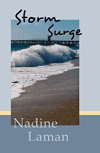
Usually titles come easy for me, except in the case of Storm Surge. By the time that third book was written, it had rules for the title: Two words (not necessarily the alliteration it turned out being), and it had to have something to do with a beach that fit the storyline. Whether that end was achieved will be decided by the readers. You tell me.

The title of a manuscript is the "working title." When writers talk about their manuscript they usually shorten the title to initials or one word. As time passes, the title becomes the embodiment of the story, our passion for writing it, and the paternal/maternal instinct we have developed for the work and the process. We have bonded.

The surprise for most writers is the publisher often wants to change the title. That change is driven by a marketing mentality. However, we writers have bonded with the working title and want it to be the real title.

Luckily, we adapt and accept the title change. The Practice became The Doctor, The Plutocrat, and The Mendacious Minister. We struggled with several interim choices, until author Glyn Pope came up with the title. Now, I can't imagine the book having any other title.

If you struggle with titles, here is an excellent piece that quite clearly spells out the process. This would also be a fun exercise for writing groups. Follow the link: http://www.npr.org/blogs/monkeysee/2011/11/09/142173673/how-to-name-your-first-novel

Sunday, October 30, 2011

Which is the most important to you?

Assuming the absurd that it isn't the whole package, what is the one ingredient of a book that is the most important piece? Which would you chose: the story, the editing, the layout, the quality of the final product, the cover art, or something else?

Tuesday, October 25, 2011

Sensory Dos and Don'ts

One thing that easily gets overlooked in writing is the sensory component. After the storyline is solid, the characters have unique personalities, and all the settings are imaginable for the reader, it is time to go though and make sure that there is sensory input.

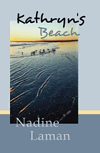
We need to feed, not overfeed, the five senses of the reader. Consider it surround sound, but for all the senses. For example, when I write about the beach in Kathryn's Beach, occasionally there is mention of the hard packed wet sand. The dry sand sifts through her fingers, but it isn't just sand, there are shell bits (and assumed other stuff).

This is not the place to wax literary and go over the top with adjectives and adverbs in every sentence. Remember that less is more. Remember that the reader is an intelligent person with stores of experiences to tap. Avoid switching into the telling mode. Hint at things with simple additions, rather than lengthy descriptions. Allow the reader to tap their knowledge from a key descriptive word.

Keep the momentum of the story moving forward, rather than diverting to sidelines to describe things in detail. Not always, of course, but once in a while note a significant change in smell when changing venue. If something is different from what one would expect, for example a quiet bar, then briefly mention it. Or a fishing boat mysteriously floating unattended for days - wouldn't there be the smell of rotting fish from the morning catch on some fateful day? Basically, you don't want to have something obvious missing from the scene.

Visualize your story and once in a while add a small prop to the set. Read your ms aloud to a friend and both of you look for places where sensor items are missing. Avoid overloading the senses and it getting in the way of the storytelling.

Let me know if you try this and how it worked for you.

Sunday, October 9, 2011

Getting Noticed

There are so many people writing these days and so few major publishers. Most large publishers use literary agents as a means of screening manuscripts; getting rid of the awful ones up front. Publishers who don't charge a fee to publish works, screen heavily to find the best bets before backing the project with company funds.

Writers use blogs, twitter, and facebook to get noticed. Writing samples are posted their websites and writing forums. Here is a new one: http://thenextweb.com/media/2011/10/03/pubslush-launches-a-kickstarter-platform-for-book-publishing. If you read the article, you know as much as I know about it. I'm not endorsing it one way or the other; just tossing out this bit of information for you to check out.

I've seen bulk queries come through that obviously are a shotgun attempt born out of desperation to get past the first hurtle and have their full ms requested. To date, every query letter I've received that began, "Dear Sir" hasn't made it past me to the vetting committee.

One committee person asked to read my rejects before I wrote the rejection email, then sent a note that they agreed that the work was so substandard that it wasn't worth taking it to the full committee.

It is extremely important to put your best effort forward every time. You only get one shot at a first impressions and the competition is stiff.

Try not to query when you're tired, feeling low from a rejection letter, or hurried. It will make a difference if you're rested and feeling confident about your work.

If you've self published, you know that your book gets turned away from some sites and some reviewers. It isn't a level playing field. Take a look at this place: http://filedby.com/author/nadine_laman/2238025.

No matter what, write your best work and believe in yourself and your ms.

Sunday, October 2, 2011

What is a fair price for eBooks?

Nearly weekly, but likely more often, the trade news (publishing industry) has an article on the price of ebooks.

Usually the blog or article is stating that ebooks cost nothing after they are posted and should, therefore, be priced extremely low. (Keep in mind the distributor needs to make money to keep their company running so the ebook is available in the first place.)

Obviously those people haven't written a book and don't think an author should make any money on it for the life of the work. That is about like saying a museum should only charge a person once in their life to view an exhibit. How many people donate to their favorite museum to pay to keep the lights on and the doors open?

The reality is that any book, ebook or paper, has to support the author and the business that published it and it won't do it in one sale. It is a bit-by-bit process and a huge gamble that X number of copies will sell to pay for the expense to publish it.

Even with ebooks, a company has to continually keep the lights on and pay people to manage the records...at the bare minimum. (And if you are a writer, you want the company to be able to afford the resources to publish your book with its funds.)

If that company needs to upgrade or replace broken equipment and pay ever increasing taxes, how would that work out with only charging the actual expense of an ebook(remember that ebooks have to pay the distributor too).

I love what I do, but I do want to point out that products, including books, have to support the "manufacturer." Each book is like creating a new car - it requires company resources.

That is my take on why books cost money. And remember the publisher and the author get nothing from books lent to friends and family, or sold at garage sales. The business model, especially in this world economy, has to not be a charity (business is in business to make money).

History judges a society more by its arts than its wars. As people, we tend to expect arts to be gifts, yet understand that war costs money. Consider this, between Sparta and Athens, which still exists?

Until now, I've kept my opinion to myself. I think it is not likely that anyone would go to their job every day and get no paycheck. Something for nothing doesn't sustain the economy. What's your opinion on this?

Friday, August 26, 2011

Blog Party

Two years ago at this time, we were in the middle of the most incredible blog party. It started out to be a one day deal to celebrate my 100th post. The joke was that I'd been a member of blogger for a couple of years before I created a blog and really had no interest in blogging (a lot like I feel about Facebook and Twitter now).

If you were part of the blog party, take a trip down memory lane with the link at the end of this post.

If you have no idea what I'm talking about, check it out. It was worldwide and unbelievable.

I have two copies of the limited edition of the total blog party in bound form. If you want one, order through the link in the left sidebar. Click on the book cover in this post to see a larger image.

http://nadinelaman.blogspot.com/2009/08/99.html

Tuesday, August 23, 2011

Read any good books lately?

It's five AM and the mowers are rolling across the golf course (I hate that noise!). I'm sorting through emails before work.

Work? Yes, by day I'm a social worker who works with people who have developmental disabilities. Pretty cool job.

Anyway, the point I'm aiming for is that amidst the email from the lawyer and the advertisement with coupon for business supplies, is the daily feed of publishing news.

There is an article or two about price fixing and how eBooks are too expensive (really? it isn't my fault you bought an expensive eReader).

Forgotten is the time and expertise that goes into creating a book out of an ms. Not to mention that there are several prevailing digital formats to address. Am I the only one who remembers BETA and VHS?

The discussion should be a bit less about price (and price fixing) and a bit more about content. What is a well crafted story worth?

Sunday, August 14, 2011

Desert Storms and Rewrites


I sat on the patio this afternoon, well used to the heat, and read mss. This is a photo of the monsoons rolling across the desert.

I've given a lot of thought to how specific I should be about rewrite requests to the CRP authors. The other day I asked my friend Jen Garsee what kind of direction she gets for her rewrites.

I know she disappears when she is doing rewrites and it isn't until they are done, by the deadline, that anyone hears from her. Jen writes for one of the major publishers and has her third YA novel coming out soon. (Links below.)

Here is what she said, which makes me think I do far too much handholding:
The rewrites depend on the book. I had a TON of rewrites with Before.After...almost none with Say The Word...and a lot of editing in the third-- not really rewrites, just needed to cut and tighten. Luckily my agent gives me a lot of advice before it even goes out to my editor [at Bloonsbury USA Children's Books].

ps The rewrite suggestions are never detailed. They just say "I need a scene with blah blah" or "Can you make this character a bit more likeable?" or "We need a transition here..." I have to figure it out myself lol.

Jeannine Garsee
THE UNQUIET (2012)
SAY THE WORD
BEFORE, AFTER, AND SOMEBODY IN BETWEEN
Bloomsbury USA Children's Books

Check out Jen...she writes hysterical blogs.

http://www.jeanninegarsee.com/
http://onegrapeshy.livejournal.com/profile
http://jeanninegarsee.blogspot.com/


For more Arizona weather info: We've had several haboobs - it is a strong wind in the desert; a sand storm. http://www.abc15.com/dpp/news/region_southeast_valley/queen_creek/photos%3A-haboob-moves-across-south-valley