Short and sweet, here is the quote of the day:
I amazed at how people think they if read a few novels,they could write one. That is like getting a tattoo and thinking they could then open a tattoo salon.
Wednesday, July 27, 2011


Saturday, July 23, 2011
Plot/Storyline
Often I use the term, 'storyline,' when referring to mss. The recognized industry term is 'plot.' Plot is more than a beginning, middle and end. It is more than the outline from which the story is built.
Plot is the most important element of fiction writing. The plot has to deliver for the reader to feel satisfied with the story. There are style expectations for each type of plot. The reader expects those elements and it's the writer's job to deliver.
First time writers who haven't studied writing often forget about the reader's expectations and the industry demands while in the midst of the feel-good high of writing. I would submit that there is a bio-chemical/emotional high to writing that is as addicting as the one people who exercise feel.
The point of writing, the craft of it, is the reader and the integrity of the art. Much like photography where anyone can take a snapshot with their phone, that doesn't make it a professional photograph (and don't get me started on photoshopped images).
Just so you know how this all fits together, the second important, nearly equally important, element is character. Characters have to have dimension. In one of the first writing classes I took, one assignment was to categorize a list of characters in a story [we read] as flat or round. The character's action and words (dialogue) fill in the life breath to make them real for the reader. By the way, there needs to be a balance of both types of characters in the story.
If there is no plot, the story is simply a collection of words that recount an event in part or in whole. That is largely why I'm not a huge fan of memoirs. Unless well done, they are [to me] much like reading a history book and it isn't a shared history, so why should I [as the reader] care?
There are lots of books on the subject of plot development, here is one I recently read: 20 Master Plots and how to build them by Ronald B Tobias, published by Writer's Digest Books. If you're looking for writing resources, check out Writer's Digest Books. Most of their books are pretty good. A few, I found to be dry reads. Also, shop around and price compare. I found substancial discounts by doing that. Be warned, though, their book list is like sending a kid to a candy store with $10 in their pocket.
Just to cover the legal requirements, I have not been compensated monetarily or in kind to mention the book, author, or publisher in this post.
Plot is the most important element of fiction writing. The plot has to deliver for the reader to feel satisfied with the story. There are style expectations for each type of plot. The reader expects those elements and it's the writer's job to deliver.
First time writers who haven't studied writing often forget about the reader's expectations and the industry demands while in the midst of the feel-good high of writing. I would submit that there is a bio-chemical/emotional high to writing that is as addicting as the one people who exercise feel.
The point of writing, the craft of it, is the reader and the integrity of the art. Much like photography where anyone can take a snapshot with their phone, that doesn't make it a professional photograph (and don't get me started on photoshopped images).
Just so you know how this all fits together, the second important, nearly equally important, element is character. Characters have to have dimension. In one of the first writing classes I took, one assignment was to categorize a list of characters in a story [we read] as flat or round. The character's action and words (dialogue) fill in the life breath to make them real for the reader. By the way, there needs to be a balance of both types of characters in the story.
If there is no plot, the story is simply a collection of words that recount an event in part or in whole. That is largely why I'm not a huge fan of memoirs. Unless well done, they are [to me] much like reading a history book and it isn't a shared history, so why should I [as the reader] care?
There are lots of books on the subject of plot development, here is one I recently read: 20 Master Plots and how to build them by Ronald B Tobias, published by Writer's Digest Books. If you're looking for writing resources, check out Writer's Digest Books. Most of their books are pretty good. A few, I found to be dry reads. Also, shop around and price compare. I found substancial discounts by doing that. Be warned, though, their book list is like sending a kid to a candy store with $10 in their pocket.
Just to cover the legal requirements, I have not been compensated monetarily or in kind to mention the book, author, or publisher in this post.
Friday, July 15, 2011
Storytelling
Quite simply, anyone can tell a story if they start at the beginning and go to the end. However, some people have trouble knowing where the beginning is and start before the beginning. Some people try to put in every detail of the backstory. Other people drop in things they forgot to mention and later need to tell to make something make sense or work.
The other important part is to know when to stop. When there is a group of listeners who become restless, then it is likely that it took too long to get to the point, or the storyteller kept going after it was finished.
But more than that, a writer has to engage the reader to care about the characters and what is coming next. Just because a person can tell a story, doesn't mean they can write a novel.
Make sure you write about people who other people can care about and put them in a setting that the reader can experience too.
Write well. Tell your best story.
The other important part is to know when to stop. When there is a group of listeners who become restless, then it is likely that it took too long to get to the point, or the storyteller kept going after it was finished.
But more than that, a writer has to engage the reader to care about the characters and what is coming next. Just because a person can tell a story, doesn't mean they can write a novel.
Make sure you write about people who other people can care about and put them in a setting that the reader can experience too.
Write well. Tell your best story.
Saturday, July 9, 2011
"What's all the haboob about?"
It must have been a slow news day or we are mesmerized about weather with all that is going on around the world.
Most people heard there was a haboob in Phoenix last Tuesday. (Google it, there are plenty of YouTube videos of it.)
A haboob is a wall of sand, much like a desert Tsunami. It's approach is visible on the horizon. It churns as if waves coming inland.
When it hits, it is like a tan blizzard, obscuring the houses across the way from view.
As long as one isn't driving in it, it is interesting to watch the sand blow sideways since the desert sand is not fine like beach sand.
Oddly, when there wasn't even a breeze, a tree fell over in my yard this afternoon. It was good timing since tonight there is another haboob from the opposite direction. I suppose all the sand will return to where it was a week ago.
This has nothing to do with writing or publishing, but since I had so many emails about it, I thought I'd mention it.
Most people heard there was a haboob in Phoenix last Tuesday. (Google it, there are plenty of YouTube videos of it.)
A haboob is a wall of sand, much like a desert Tsunami. It's approach is visible on the horizon. It churns as if waves coming inland.
When it hits, it is like a tan blizzard, obscuring the houses across the way from view.
As long as one isn't driving in it, it is interesting to watch the sand blow sideways since the desert sand is not fine like beach sand.
Oddly, when there wasn't even a breeze, a tree fell over in my yard this afternoon. It was good timing since tonight there is another haboob from the opposite direction. I suppose all the sand will return to where it was a week ago.
This has nothing to do with writing or publishing, but since I had so many emails about it, I thought I'd mention it.
Wednesday, June 15, 2011
Tempus Fugit
Lately there has been more than the usual emails asking if the current work is finished and if I now have time to read xyz ms.
I don't think anyone realizes how many times I go through a ms pending publication. I can almost quote it by the last reading (marking all over it). It is a wonder the author (any author) still emails me after all the times the ms has been sent back for rewrites. On the other hand, not every publisher has the patience for works that require multiple rewrites.
Most of the time it has been a gracious exchange with many patiently withheld frustrations - I'm sure. The ones who won't do rewrites get sent packing.
Here's why: http://publishingperspectives.com/2011/06/learn-the-fking-rules-grammar
I don't think anyone realizes how many times I go through a ms pending publication. I can almost quote it by the last reading (marking all over it). It is a wonder the author (any author) still emails me after all the times the ms has been sent back for rewrites. On the other hand, not every publisher has the patience for works that require multiple rewrites.
Most of the time it has been a gracious exchange with many patiently withheld frustrations - I'm sure. The ones who won't do rewrites get sent packing.
Here's why: http://publishingperspectives.com/2011/06/learn-the-fking-rules-grammar
Tuesday, June 14, 2011
Wimpy Words
Sometimes beginning writers are apologetic without realizing it. It shows in word choices. At some point in the process of transforming an ms to a publishable book, I go through metnodically and evaluate the strength of each sentences, word by word.
I'm looking at the following:
Clarity - does it say what the writer meant?
Continuity - the connected whole (without jumping around in time or big gaps that are distracting).
and
Wimpy words - words that drain the energy or strength from the sentence.
Most people know (or have heard of) the eight parts of speech. I often mention that there are 48 prepositions because my youngest child counted then and it stuck in my mind. As a side bar, I don't think it is necessary to memorize them as was my son's school assignment, but it is worth having a sense of what they are so you know them when you see them.
What I think we do too little of is diagram sentences. That's where clarity gets sorted. A missing punctuation (as exampled by the book title, Eats, Shoots & Leaves) or a misplaced modifier can have humerous and possibly disasterous results. That is where diagraming a troubling sentence can help sort the problem.
Wimpy words are the easiest to fix. Simply delete them. But what is a wimpy word (a term I coined, I think)?
But what is a wimpy word? We use them in everyday conversations and in our head as we write. They are words that weaken the dynamics of the story.
It was almost 5:00. Since this is fiction, it doesn't have to be exact. Remove almost and read it again. Stronger? The added bonus in removing almost is it picks up the pace. Pacing is important in keeping the reader from disengaging with the story. (More on that some other time.)
As everything else in First Draft, this is strictly my opinion, and I'll have to add to the list as time goes on because I only think of them as I'm reading an ms (hopefully they aren't in professionally published books).
Always, almost, any, often, sometimes, about, and (to connect thoughts when it should be two sentences rather than one), even, nearly, also, each, both, and others I haven't thought of at the moment. A few of these words goes a long ways.
As you read through line by line, with a magnafying glass in your mind, notice these, then run a search for them. Keep only the essential ones and delete the rest. Less is more. By keeping the ones that really matter in the sentence, they are more powerful. The nonessential ones weaken the sentence.
My personal trigger is and then. It slows down the pace horibally to use both, pick one. I know I'm crossing the line on grammar rules, but it bugs me to have both words together.
And if you get bored with that, run a search for places you have two blank spaces after a period/full stop. Replace them with one blank space.
I'm looking at the following:
Clarity - does it say what the writer meant?
Continuity - the connected whole (without jumping around in time or big gaps that are distracting).
and
Wimpy words - words that drain the energy or strength from the sentence.
Most people know (or have heard of) the eight parts of speech. I often mention that there are 48 prepositions because my youngest child counted then and it stuck in my mind. As a side bar, I don't think it is necessary to memorize them as was my son's school assignment, but it is worth having a sense of what they are so you know them when you see them.
What I think we do too little of is diagram sentences. That's where clarity gets sorted. A missing punctuation (as exampled by the book title, Eats, Shoots & Leaves) or a misplaced modifier can have humerous and possibly disasterous results. That is where diagraming a troubling sentence can help sort the problem.
Wimpy words are the easiest to fix. Simply delete them. But what is a wimpy word (a term I coined, I think)?
But what is a wimpy word? We use them in everyday conversations and in our head as we write. They are words that weaken the dynamics of the story.
It was almost 5:00. Since this is fiction, it doesn't have to be exact. Remove almost and read it again. Stronger? The added bonus in removing almost is it picks up the pace. Pacing is important in keeping the reader from disengaging with the story. (More on that some other time.)
As everything else in First Draft, this is strictly my opinion, and I'll have to add to the list as time goes on because I only think of them as I'm reading an ms (hopefully they aren't in professionally published books).
Always, almost, any, often, sometimes, about, and (to connect thoughts when it should be two sentences rather than one), even, nearly, also, each, both, and others I haven't thought of at the moment. A few of these words goes a long ways.
As you read through line by line, with a magnafying glass in your mind, notice these, then run a search for them. Keep only the essential ones and delete the rest. Less is more. By keeping the ones that really matter in the sentence, they are more powerful. The nonessential ones weaken the sentence.
My personal trigger is and then. It slows down the pace horibally to use both, pick one. I know I'm crossing the line on grammar rules, but it bugs me to have both words together.
And if you get bored with that, run a search for places you have two blank spaces after a period/full stop. Replace them with one blank space.
Sunday, June 12, 2011
Wondering...
I'm a year older now...no, today isn't my birthday, but it was a few days ago. I'm huge on reflecting and planning, especially when landmarks come and go.
One thing I'm wondering is whether I have any more awesome bits of wisdom to pass on to budding writers. Not that I'd want you to wade through all the posts to find the information, but haven't I said it all by now?
What questions do you have about writing? Let's see if anyone leaves questions in the comment section. Or even comments in the comments. Also, if you think it is time to retire this blog, say so...you can use the anonymous setting, if you'd like.
One thing I'm wondering is whether I have any more awesome bits of wisdom to pass on to budding writers. Not that I'd want you to wade through all the posts to find the information, but haven't I said it all by now?
What questions do you have about writing? Let's see if anyone leaves questions in the comment section. Or even comments in the comments. Also, if you think it is time to retire this blog, say so...you can use the anonymous setting, if you'd like.
Sunday, May 29, 2011
Stop!
Frankly, most first time writers think they are finished when the first draft is written. Trust me, it is just the beginning. That is why it is called a 'draft.'
I don't care if your mother, lover, or best friend says it is wonderful. It is not. What they probably mean is they think YOU are wonderful. And that is probably true.
As a side note, I just read an article about how many people in America think they should (and could) write a novel. If I find it again, I'll post the link at the bottom.
The reality is that most people who write are hobbyists. Being a professional writer is a different mind-set. For one thing, those people study the craft. It is pure BS that you can learn to write well by reading tons of novels. It shows when I read a submitted ms and no study into the craft has been done by the writer, though their library card is well worn.
There are very few natural writers who write at the professional level from day 1. I only know of one writer like that.
So what about everyone else, the non-naturals, who has a passion for writing? I'd say, harness that passion and drive. Take your writing to the next level. Study the craft. Study the industry (which is far less interesting than studying writing). Get serious and disciplined with your writing time. Talk is cheap. Get some ink on the paper.
Write the first draft straight through. Some people like to make an outline first, but I think that is best suited for non-fiction and it drains some of the energy out of the story if too much time is invested in writing an outline for a novel.
Plus, I contend that with an outline, the writer knows things that never get in the book, and that leaves the reader in the dark. They are expected to make leaps when the writer could have easily provided the stepping stones - those tidbits that were in the outline.
Basically, a writer needs to know where their characters are at the beginning and where they want them to be, developmentally, at the end. Find your starting point and write to the end point. If you've learned about the craft, you know how the journey from beginning to end should look on paper. A professional knows how to write a good middle story.
Some people think they need to edit-on-the-fly as they write the first draft. I can tell those who have edited one chapter before writing the next one. It has a disjointed feel to it when I read it. I don't know how else to explain it. Even if I like them, I 'pass' on the ms because it is too much work to fix the flow of energy that should be there.
The correct way to write a draft for a novel is to write from the beginning to end, straight through. Keep your eye on the prize. If you get preachy, it shows. If you go on a side excursion, it shows.
Besides stopping too soon, such as when the first draft is done, some writers do one or two edits and think it is done. Even if a line editor is hired, most do not provide content editing. The only suggestion I'll make on that is to print the whole ms on paper, get a friend who has not read your draft, sit for a whole weekend, and read it aloud to them. Even if you have to go it alone, read it aloud and listen to what is on the page.
Watch for stiff dialogue. How many of us speak grammatically correct in our conversations? Watch for time warps. Watch for telling the reader what is happening rather than showing them. Watch for side excursions where a secondary character tries to upstage the main character. (You can write a novel featuring them some other time.) Of course, you'll see lots of typos. Watch for homonyms and synonyms gone awry. Watch for sentences that are too long (how many breaths did it take to get through that one?). Watch for recycling unusual words too many times. Watch for places that are simply boring as hell and don't move the story forward.
The sooner you read your ms aloud from paper, the shorter the polishing process is...that means the fewer rewrites you will need to do.
There is one odd thing that always seems to happen. As soon as you submit your ms to someone with the hope of a publishing contract, you will see previously hidden mistakes that begin to glare at you and probably would glow in the dark if you were brave enough to turn out the lights.
I get follow-up emails with a horrified panicky tone. If the query letter is well done, and the synopsis is correctly done (and interesting to me), I can over look errors in the ms - providing there aren't a million of them and the writing is still solid.
However, that said, there are so many people writing these days due to laptops vs the manual typewriter, that it is worth it not to submit without letting the ink dry and reading the whole ms again before submitting it to anyone.
And the final word on the topic of "stop" is to not over write. Stop when the story is done. Some people like to keep writing and writing, and writing, because writing is fun. But you have to think about when the reader will feel the story is finished and stop there.
Go! Write your best work!
www.publishingperspectives.com/2011/05/200-million-americans-want-to-publish-books
I don't care if your mother, lover, or best friend says it is wonderful. It is not. What they probably mean is they think YOU are wonderful. And that is probably true.
As a side note, I just read an article about how many people in America think they should (and could) write a novel. If I find it again, I'll post the link at the bottom.
The reality is that most people who write are hobbyists. Being a professional writer is a different mind-set. For one thing, those people study the craft. It is pure BS that you can learn to write well by reading tons of novels. It shows when I read a submitted ms and no study into the craft has been done by the writer, though their library card is well worn.
There are very few natural writers who write at the professional level from day 1. I only know of one writer like that.
So what about everyone else, the non-naturals, who has a passion for writing? I'd say, harness that passion and drive. Take your writing to the next level. Study the craft. Study the industry (which is far less interesting than studying writing). Get serious and disciplined with your writing time. Talk is cheap. Get some ink on the paper.
Write the first draft straight through. Some people like to make an outline first, but I think that is best suited for non-fiction and it drains some of the energy out of the story if too much time is invested in writing an outline for a novel.
Plus, I contend that with an outline, the writer knows things that never get in the book, and that leaves the reader in the dark. They are expected to make leaps when the writer could have easily provided the stepping stones - those tidbits that were in the outline.
Basically, a writer needs to know where their characters are at the beginning and where they want them to be, developmentally, at the end. Find your starting point and write to the end point. If you've learned about the craft, you know how the journey from beginning to end should look on paper. A professional knows how to write a good middle story.
Some people think they need to edit-on-the-fly as they write the first draft. I can tell those who have edited one chapter before writing the next one. It has a disjointed feel to it when I read it. I don't know how else to explain it. Even if I like them, I 'pass' on the ms because it is too much work to fix the flow of energy that should be there.
The correct way to write a draft for a novel is to write from the beginning to end, straight through. Keep your eye on the prize. If you get preachy, it shows. If you go on a side excursion, it shows.
Besides stopping too soon, such as when the first draft is done, some writers do one or two edits and think it is done. Even if a line editor is hired, most do not provide content editing. The only suggestion I'll make on that is to print the whole ms on paper, get a friend who has not read your draft, sit for a whole weekend, and read it aloud to them. Even if you have to go it alone, read it aloud and listen to what is on the page.
Watch for stiff dialogue. How many of us speak grammatically correct in our conversations? Watch for time warps. Watch for telling the reader what is happening rather than showing them. Watch for side excursions where a secondary character tries to upstage the main character. (You can write a novel featuring them some other time.) Of course, you'll see lots of typos. Watch for homonyms and synonyms gone awry. Watch for sentences that are too long (how many breaths did it take to get through that one?). Watch for recycling unusual words too many times. Watch for places that are simply boring as hell and don't move the story forward.
The sooner you read your ms aloud from paper, the shorter the polishing process is...that means the fewer rewrites you will need to do.
There is one odd thing that always seems to happen. As soon as you submit your ms to someone with the hope of a publishing contract, you will see previously hidden mistakes that begin to glare at you and probably would glow in the dark if you were brave enough to turn out the lights.
I get follow-up emails with a horrified panicky tone. If the query letter is well done, and the synopsis is correctly done (and interesting to me), I can over look errors in the ms - providing there aren't a million of them and the writing is still solid.
However, that said, there are so many people writing these days due to laptops vs the manual typewriter, that it is worth it not to submit without letting the ink dry and reading the whole ms again before submitting it to anyone.
And the final word on the topic of "stop" is to not over write. Stop when the story is done. Some people like to keep writing and writing, and writing, because writing is fun. But you have to think about when the reader will feel the story is finished and stop there.
Go! Write your best work!
www.publishingperspectives.com/2011/05/200-million-americans-want-to-publish-books
Thursday, May 26, 2011
O'dark thirty
Translation: It is entirely too early for "them" to be out there on the golf course mowing before 5 AM. Who can possibly love golf enough to welcome the intrusion into their sleep hours? (Not me!) Yesterday morning they were out with gas powered saws trimming the trees at the crack of dawn. Really, guys?
It isn't all that different to get caught up with writing the next Great American Novel and not think about anything else.
Here are some things to think about. If you're going to write a historical novel, study the time period. That means do more research than read other historical novels.
There is something to be said about the maxim, write what you know. Several years ago, someone was writing a novel set in Southern California - my neck of the woods, so to speak. They had never been to America. The story premise was interesting, but it should have been set somewhere the author knew.
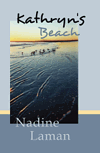
One thing about the beach scenes in Kathryn's Beach that strikes universal is the inclusion of the spray and the gritiness of being on the beach. (Go to the video page of http://www.nadinelamanbooks.com/ and watch both videos.)
When we lived in the Midwest, we would watch movies set in the western desert. I always perked up when I saw areas in the Mojave Desert in California, because I spent equal amounts of my childhood in that high desert region. It is much different from the Sonoran Desert of Arizona.
Besides setting, switching to dialects or nationalities requires attention to detail. Consult a local person to read your ms for authenicity. The homeless woman in Kathryn's trilogy speaks with an Appalachian drawl. Did I get it right? It isn't critical because that was her street persona, not the real person she was. But it is believable enough to pass inspection until her real identity is revealed.
Basically, don't get caught up in the rush of writing and forget that someday someone will read it. And if that someone is not your mother, lover, or best friend, they are going to notice things like the moon rising at 2 AM or the slight misspeaks your characters do.
There are thousands of people with laptops ticking out a novel. If you want published, you have to get it right because someone else out there is determined enough to pay attention to the details. The Cactus Rain team notices this stuff.
If you want to get ahead of everyone else, print your ms (yes, on paper) and read it aloud. Yes, ALOUD. You can be sure I will do that to your ms before offering a contract to publish.
It isn't all that different to get caught up with writing the next Great American Novel and not think about anything else.
Here are some things to think about. If you're going to write a historical novel, study the time period. That means do more research than read other historical novels.
There is something to be said about the maxim, write what you know. Several years ago, someone was writing a novel set in Southern California - my neck of the woods, so to speak. They had never been to America. The story premise was interesting, but it should have been set somewhere the author knew.
One thing about the beach scenes in Kathryn's Beach that strikes universal is the inclusion of the spray and the gritiness of being on the beach. (Go to the video page of http://www.nadinelamanbooks.com/ and watch both videos.)
When we lived in the Midwest, we would watch movies set in the western desert. I always perked up when I saw areas in the Mojave Desert in California, because I spent equal amounts of my childhood in that high desert region. It is much different from the Sonoran Desert of Arizona.
Besides setting, switching to dialects or nationalities requires attention to detail. Consult a local person to read your ms for authenicity. The homeless woman in Kathryn's trilogy speaks with an Appalachian drawl. Did I get it right? It isn't critical because that was her street persona, not the real person she was. But it is believable enough to pass inspection until her real identity is revealed.
Basically, don't get caught up in the rush of writing and forget that someday someone will read it. And if that someone is not your mother, lover, or best friend, they are going to notice things like the moon rising at 2 AM or the slight misspeaks your characters do.
There are thousands of people with laptops ticking out a novel. If you want published, you have to get it right because someone else out there is determined enough to pay attention to the details. The Cactus Rain team notices this stuff.
If you want to get ahead of everyone else, print your ms (yes, on paper) and read it aloud. Yes, ALOUD. You can be sure I will do that to your ms before offering a contract to publish.
Thursday, May 12, 2011
My Mother Hen Moment
There is so much great information on the Internet for beginning writers. It is easy to get overwhelmed with the process of distilling the information. Certainly, I believe, there are better blogs than mine, though I don't know which they are, nor do I really care who is better than me, as long as I'm my best.
Writing is a craft. It is also an art. It is also a profession. Here are a few tips, and as always, they are IMO. (IMO is In My Opinion. Most often it is IMHO, but there is nothing humble about my opinion. I very rarely apoligize for it or for calling it like I see it, therefore, forget thinking I'm humble when it comes to this craft and this industry.)
Okay...here we go!
It takes most people hours, months, and sometimes years to write a novel. I'm among the fortunate few who can write a complet draft in 40 hours, eg, a couple hours a day for three weeks.
That said, it totally amazes me that such lack of care is given to soliciting publication. Seriously, folks, this isn't an entitlement. Anyone wanting to be part of this wonderful and sometimes bizzare thing of writing must put at least equal effort into the submission process as into the writing process.
Here are a few obvious things that result in me not reading the first three chapters of a submitted ms: When a query letter begins, "Dear Sir," it is nearly sudden death then and there. Besides the fact, that as a woman, it annoys the hell out of me to be addressed as "Sir," it also indicates that the person sending the query hasn't bothered to find out if I am a sir.
A quick look at Cactus Rain Publishing's website reveals my name. A google will find First Draft, and I'm pretty sure the photo of me doesn't look like a "Sir."
The next arogant thing that catches my attention is the brush off query letter. It goes like this: I wrote this novel (please don't say "fiction novel" - novels ARE fiction) and have attached the synopsis and first three chapters for you to read.
It tells me nothing about the submission, assuming I'll jump over the correctly written query letters and rush to read the synopsis attached. Um...let me think on that...um, no.
This isn't a complete list of what should go into a query letter, but it is a business letter that is your first and best attempt to get the reader to consider the ms. It should include the genre, the length (word count), and a two or three sentence paragraph that pitches the the manuscript (ms).
The pitch to readers (blurbs and such) is different from the pitch to an agent or publisher. There should be no fluff to it. For example, Kathryn's Beach is an 80,000 word contemporary woman's lit story of a social worker who returns to face the case that ended her career. It is set in Southern California near Los Angeles. That is very bare bones and wouldn't get a reader excited, but in this case, that isn't the point of the pitch.
The next problem area that results in a decline email is the synopsis. There is a search feature for this blog in the sidebar to the left. Search 'synopsis' for tips about the form and substance of synopsis, especially if you intend to query Cactus Rain.
It is heartbreaking to tell hopeful authors that their work is not a good fit for Cactus Rain. But at least it shouldn't be because the query process was slopped together and doesn't represent the work submitted or the writer's intent to become a professional, not a hobbiest.
Good writing, good luck, and God-speed.
Writing is a craft. It is also an art. It is also a profession. Here are a few tips, and as always, they are IMO. (IMO is In My Opinion. Most often it is IMHO, but there is nothing humble about my opinion. I very rarely apoligize for it or for calling it like I see it, therefore, forget thinking I'm humble when it comes to this craft and this industry.)
Okay...here we go!
It takes most people hours, months, and sometimes years to write a novel. I'm among the fortunate few who can write a complet draft in 40 hours, eg, a couple hours a day for three weeks.
That said, it totally amazes me that such lack of care is given to soliciting publication. Seriously, folks, this isn't an entitlement. Anyone wanting to be part of this wonderful and sometimes bizzare thing of writing must put at least equal effort into the submission process as into the writing process.
Here are a few obvious things that result in me not reading the first three chapters of a submitted ms: When a query letter begins, "Dear Sir," it is nearly sudden death then and there. Besides the fact, that as a woman, it annoys the hell out of me to be addressed as "Sir," it also indicates that the person sending the query hasn't bothered to find out if I am a sir.
A quick look at Cactus Rain Publishing's website reveals my name. A google will find First Draft, and I'm pretty sure the photo of me doesn't look like a "Sir."
The next arogant thing that catches my attention is the brush off query letter. It goes like this: I wrote this novel (please don't say "fiction novel" - novels ARE fiction) and have attached the synopsis and first three chapters for you to read.
It tells me nothing about the submission, assuming I'll jump over the correctly written query letters and rush to read the synopsis attached. Um...let me think on that...um, no.
This isn't a complete list of what should go into a query letter, but it is a business letter that is your first and best attempt to get the reader to consider the ms. It should include the genre, the length (word count), and a two or three sentence paragraph that pitches the the manuscript (ms).
The pitch to readers (blurbs and such) is different from the pitch to an agent or publisher. There should be no fluff to it. For example, Kathryn's Beach is an 80,000 word contemporary woman's lit story of a social worker who returns to face the case that ended her career. It is set in Southern California near Los Angeles. That is very bare bones and wouldn't get a reader excited, but in this case, that isn't the point of the pitch.
The next problem area that results in a decline email is the synopsis. There is a search feature for this blog in the sidebar to the left. Search 'synopsis' for tips about the form and substance of synopsis, especially if you intend to query Cactus Rain.
It is heartbreaking to tell hopeful authors that their work is not a good fit for Cactus Rain. But at least it shouldn't be because the query process was slopped together and doesn't represent the work submitted or the writer's intent to become a professional, not a hobbiest.
Good writing, good luck, and God-speed.
Subscribe to:
Posts (Atom)



 When Paul Fenton stops for breakfast in a small town, he gets more than he bargained for in the process.
 When two-hundred-year-old human remains are discovered on one of Neptune's moons, Earth's history falls into question.
 Emily's husband persuades her to try thalidomide to ease her symptoms as she is unaware of the devastating effects.
 Who is the women's shelter bomber? Melissa Ryan suspects that her husband knows.
 Further developments with the Wilder family.
 A hidden past shakes the O'Donovan family to its core
 A swirl of emotion and choice, set in Cape Town, South Africa
 Love is a constant, but it comes at a price.
 When the road ahead is unclear, sometimes you have to rely on trust.
 The struggle between good and evil is ages old. It gets all the more complicated when the good guys aren't all good and the bad guys have redeeming qualities.
 Story of a land mothering two races of people – the light-skinned and the dark-skinned.
 A gifted Ukrainian ballerina comes into possession of a mysteriously coded address book.
 Six passengers' lives change for better or worse after they arrive in Honiton.
 Resilience and love in a harsh and unforgiving age
 Kathryn's Beach
 High Tide
 Storm Surge
