I thought the post on the link at the bottom of this page was interesting. Good lit agents work with a writer if the ms is promising, but a bit rough around the edges. It takes a lot of time to review and make suggestions, and even more time if the writer is a stubborn goat. (No offense to goats intended.)
It's maddening to spend the time and tell a writer exactly what they need to fix to make their ms competitive, at least as competitive as possible, only to have them argue the point and not budge.
It is time lost that could be spent with an equally good product and a much more willing writer.
So the question has been raised, in the link below, should lit agents charge for this service; for content editing? They charge for messenger service and such, but not ever for reading. I don't think they should charge for reading, that is part of their job. However, it takes hours and hours to work with someone to flesh out a ms, usually belonging to a debut writer. Content editing is a different process than reading to offer a contract, or not.
I am still thinking this one over, but I'm leaning toward the idea of charging a fee for content editing. These people do know the industry and what is being bought at the moment, as well as the particular interests of specific acquisition editors at various publishing houses.
The reason I'm leaning in favor of the lit agents charging for this particular services is that they could be, as I said, working with an ms that needs less work. If they could know that the time spent fleshing out promising mss was not lost, then we might see a lower rejection rate. They might accept more mss, if they knew it wouldn't be a total loss to take a chance.
Isn't that what every writer wants -- someone to take a chance on them and their ms? Who knows, some of the passed up mss might be exactly what the acquisition editors want or more importantly, what readers would like (given the opportunity) to read - if lit agents could afford to invest the time in them.
Decide for yourself. Here's the link: http://www.idealog.com/blog/literary-agents-and-the-changing-world-of-trade-publishing
Monday, November 30, 2009


Tuesday, November 24, 2009
Procrastination
 There are a million and one ways to not write.
One way is to buy writing software or go to a name generator online and play for hours deciding on a name, plot, or some other writing related detail. You can get great ideas from these.
Another thing some fiction writers do is outline the entire story, write extensive bios on the principle characters, research, research, and research some more.

Besides all the legitimate reasons that get in the way of writing, especially for moms/mums, I doodle.
When the writer's mind is gone for the day, yet I want to feel a pen in my hand (I write on the computer), I doodle with pen and ink. I don't use anything fancy, just a regular gel pen and printer paper and lots of circles and short lines. A different view of this doodle was in my December 2008 newsletter http://nadinelamanbooks.com/pdf/brag12-08.pdf
Happy Thanksgiving! I'm taking the rest of the week off!
Monday, November 23, 2009
Retro look
 Several years ago, I read an ms for Nidhi Dhawan. Nidhi is an ENT surgeon in India. Recently Nidhi and I were talking (email) about her book and I ended up designing a cover for her.
First of all, so much for my memory, I knew there was a tree in the book that figured prominently throughout the lives of two little boys, one Hindu and the other Muslim. While I was waiting for Nidhi to tell me the type of tree it was, I took a quick look in her ms for a clue.
I mocked up a cover using a tree I had drawn some time ago - see tomorrow's post. As it turned out, I had the wrong tree in mind. Then I set out to draw a Banyan tree and redo the cover since she had liked the general idea of the cover. Nevertheless, it turned out to be a good thing I got confused about the trees, as Nidhi liked the use of the Banyan tree over the Neem tree.
Take a look at the picture of these book covers in the link below. Then look at the one I designed above. http://www.guardian.co.uk/books/booksblog/2009/nov/17/penguin-designs
Some things never go out of style such as simple straight forward cover art ...me thinks. Sometimes a book will tell you what it wants. Perhaps on another day I will post the transitions of this cover.
Special thanks to Lecter Johnson for permission to use his font, xxii arabian onenightstand, in the cover art for Nidhi's book.
Friday, November 20, 2009
FREE Blog Party 09 Book
With Thanksgiving Day (in the USA) coming next week, I thought I'd offer a copy of the Blog Party 09 Book FREE as a 'thank you' for all the years of good times in this industry. The blog party was the perfect example of what I often refer to as the writers' community.
There are times this industry is difficult and times of serendipity. We share these times with each other. Take a moment and scroll through any page on the Blog Party (click the party icon on the sidebar) and see what I'm talking about.
So here's the deal. Anyone, absolutely any one is eligible to get the FREE Blog Party 09 book. This can be your first visit to my blog or we can know each other. All you have to do is send me an email, before the end of November, telling me why you want a copy of the book. FREE is free, including free shipping - world wide.
All you have to do is send me an email saying why you want the book. Easy-peasy. Put in the subject line something like, free blog party book.
Always, always, I autograph books I send.
Email address: NadineLaman [at] aol.com
Ready, set, GO!
There are times this industry is difficult and times of serendipity. We share these times with each other. Take a moment and scroll through any page on the Blog Party (click the party icon on the sidebar) and see what I'm talking about.
So here's the deal. Anyone, absolutely any one is eligible to get the FREE Blog Party 09 book. This can be your first visit to my blog or we can know each other. All you have to do is send me an email, before the end of November, telling me why you want a copy of the book. FREE is free, including free shipping - world wide.
All you have to do is send me an email saying why you want the book. Easy-peasy. Put in the subject line something like, free blog party book.
Always, always, I autograph books I send.
Email address: NadineLaman [at] aol.com
Ready, set, GO!
Thursday, November 19, 2009
Supporting Characters
Everyone knows that in a novel there is at least a main character (MC) and their antagonist - the person who makes the MC's struggle real - and secondary characters, their friends or sidekicks.
One set of characters some novice writers forget to add judiciously are the background characters - the extras in a movie. These are the people on the street, in the restaurants, or neighbors. These people help flesh out the MC.
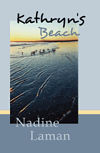
Since I can use my books without anyone's permission, I'll use them for examples. In Kathryn's Beach there is a convent. The most prominent nuns are Sister Elizabeth and her sidekick Sister Theresa. However, other nuns walk in and out of scenes, perhaps say a line or two, and leave. It wouldn't be very believable that Saint Mark's was a real convent with only two nuns. To tell the truth, I had to keep a list to remember which nun was the school principal. They weren't that important to me or to the story to remember their names. But they played an important role in making the convent and the two main nuns seem more real.
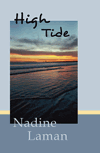
The same goes for the mention of the traffic on the freeways in Los Angeles. I don't make a big deal of it, but it would be lacking to not mention the traffic problem that caused the detour Kathryn and Sister Theresa took that lead to Sister Theresa's big question to Kathryn in High Tide. Wouldn't it seem odd to drive all over LA and never mention traffic?
Also at the airport in High Tide, even though Kathryn couldn't go to the gate now like she did, she could when the ms was written (pre-September 11, 2001). It makes sense for the traveler to bump Kathryn with their carry-on bag and the people she encounters on the escalator. LAX is a very busy airport. There had to be people in it for anyone to believe Kathryn was at LAX. Whereas, Kansas City International (KCI) closes down early and no one is around when you get off the plane - very spooky!
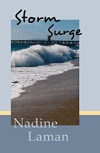
Storm Surge switches settings requiring a whole new group of background characters had to be cast, like the gardner. Some of them had been introduced in High Tide, so the trilogy carried over from one book to the next. Otherwise it would be like Kathryn had been plucked out of the two previous books and plunked down into a different story all together.
Keep in mind camera angles and you won't forget the background characters. There is always a wide angle or pan to show the other people in the location, then it narrows onto the principle characters per that scene. Pay attention to that when you watch TV and translate it to your writing - don't forget to cast a few extras in your novel.
One set of characters some novice writers forget to add judiciously are the background characters - the extras in a movie. These are the people on the street, in the restaurants, or neighbors. These people help flesh out the MC.
Since I can use my books without anyone's permission, I'll use them for examples. In Kathryn's Beach there is a convent. The most prominent nuns are Sister Elizabeth and her sidekick Sister Theresa. However, other nuns walk in and out of scenes, perhaps say a line or two, and leave. It wouldn't be very believable that Saint Mark's was a real convent with only two nuns. To tell the truth, I had to keep a list to remember which nun was the school principal. They weren't that important to me or to the story to remember their names. But they played an important role in making the convent and the two main nuns seem more real.
The same goes for the mention of the traffic on the freeways in Los Angeles. I don't make a big deal of it, but it would be lacking to not mention the traffic problem that caused the detour Kathryn and Sister Theresa took that lead to Sister Theresa's big question to Kathryn in High Tide. Wouldn't it seem odd to drive all over LA and never mention traffic?
Also at the airport in High Tide, even though Kathryn couldn't go to the gate now like she did, she could when the ms was written (pre-September 11, 2001). It makes sense for the traveler to bump Kathryn with their carry-on bag and the people she encounters on the escalator. LAX is a very busy airport. There had to be people in it for anyone to believe Kathryn was at LAX. Whereas, Kansas City International (KCI) closes down early and no one is around when you get off the plane - very spooky!
Storm Surge switches settings requiring a whole new group of background characters had to be cast, like the gardner. Some of them had been introduced in High Tide, so the trilogy carried over from one book to the next. Otherwise it would be like Kathryn had been plucked out of the two previous books and plunked down into a different story all together.
Keep in mind camera angles and you won't forget the background characters. There is always a wide angle or pan to show the other people in the location, then it narrows onto the principle characters per that scene. Pay attention to that when you watch TV and translate it to your writing - don't forget to cast a few extras in your novel.
Wednesday, November 18, 2009
Location, location, location...
Nope! I'm not looking to buy or sell property. However, location plays a major role in the setting for mss. (Actually, it applies to more than novel writing, any form of fiction needs a setting or set for scripts.)
Even though location plays a backstage role in most novels, it can have a huge impact on the believable factor for the reader. You can take the average main character (MC) and move them from one location to another unrelated location, and their behavior will adapt - or should.
While the characters, particularly the MC and the antagonist, play the largest role in getting the reader to dispense with reality and buy into your story's reality, a well done setting can help the process along.
I'm visiting in Pine, AZ, in the Tonto National Forest. This isn't the typical mountain living, like in Flagstaff or one of the Colorado mountain cities. This is where cabins are sparely placed in the forest. Many of the roads are dirt and rugged.
One thing I've learned in the short while I've been here is to scan the horizon for smoke every time I go outside. Forest fires are frequent in the Arizona forests (and in Southern California).
As we were driving up the 500 feet elevation from the town where shopping is done here, we noticed a yellow-brown haze hovering over the next ridge ahead of us. It was the kind of thing found over many US major cities, but we both scanned for the source of the smoke. Once we found the chimney of smoke was narrow and from the east of where we were headed, we resumed our conversation and proceeded up the mountain.
The point is, there are behaviors that locals do particular to their environment. Don't go overboard, but if you can add something to convince the reader who has lived in a similar location that this is true, you are one step closer to moving them to dispense with disbelief.
The converse is true. Hubby's great aunt remarked once how a fairly famous writer had the moon rise over the Mid-western plains at 2:00 AM. She threw the book in the fireplace. The moon does not rise that late in the central plains states. Actually, it should be beginning its descent by then.
While I don't want novice writers to sweat blood over every detail, do pay attention to particulars that the locals would know are pure fiction, if you're asking them to move into the world you've created in your novel and believe it is real.
On the other hand, in SciFi or fantasy, it is sometimes useful to take a known item from our world, like the moon rising, and have it behave differently. That gives the novel an other world quality. So, maybe you want the moon to rise at noon. Then you can have the characters react to that, such as saying it will be clear for the battle or the journey at hand. I think it is handy to take an element from the setting that is familiar and guide the reader to translate that item into the unreal world.
Make sure what you add to your story is there for a reason, not just filling space. Write well, enjoy the process, and take your readers with you.
TIP: Get travel videos from the library and watch the locals in the background of the host.
PITCH: I rarely pitch, but Kathryn's Beach is an excellent example of setting contributing to the character of the MC. The link to purchase is in the left sidebar of this blog.
Even though location plays a backstage role in most novels, it can have a huge impact on the believable factor for the reader. You can take the average main character (MC) and move them from one location to another unrelated location, and their behavior will adapt - or should.
While the characters, particularly the MC and the antagonist, play the largest role in getting the reader to dispense with reality and buy into your story's reality, a well done setting can help the process along.
I'm visiting in Pine, AZ, in the Tonto National Forest. This isn't the typical mountain living, like in Flagstaff or one of the Colorado mountain cities. This is where cabins are sparely placed in the forest. Many of the roads are dirt and rugged.
One thing I've learned in the short while I've been here is to scan the horizon for smoke every time I go outside. Forest fires are frequent in the Arizona forests (and in Southern California).
As we were driving up the 500 feet elevation from the town where shopping is done here, we noticed a yellow-brown haze hovering over the next ridge ahead of us. It was the kind of thing found over many US major cities, but we both scanned for the source of the smoke. Once we found the chimney of smoke was narrow and from the east of where we were headed, we resumed our conversation and proceeded up the mountain.
The point is, there are behaviors that locals do particular to their environment. Don't go overboard, but if you can add something to convince the reader who has lived in a similar location that this is true, you are one step closer to moving them to dispense with disbelief.
The converse is true. Hubby's great aunt remarked once how a fairly famous writer had the moon rise over the Mid-western plains at 2:00 AM. She threw the book in the fireplace. The moon does not rise that late in the central plains states. Actually, it should be beginning its descent by then.
While I don't want novice writers to sweat blood over every detail, do pay attention to particulars that the locals would know are pure fiction, if you're asking them to move into the world you've created in your novel and believe it is real.
On the other hand, in SciFi or fantasy, it is sometimes useful to take a known item from our world, like the moon rising, and have it behave differently. That gives the novel an other world quality. So, maybe you want the moon to rise at noon. Then you can have the characters react to that, such as saying it will be clear for the battle or the journey at hand. I think it is handy to take an element from the setting that is familiar and guide the reader to translate that item into the unreal world.
Make sure what you add to your story is there for a reason, not just filling space. Write well, enjoy the process, and take your readers with you.
TIP: Get travel videos from the library and watch the locals in the background of the host.
PITCH: I rarely pitch, but Kathryn's Beach is an excellent example of setting contributing to the character of the MC. The link to purchase is in the left sidebar of this blog.
Tuesday, November 17, 2009
More Industry News!
Sheesh, what's happening to me, I'm writing industry news two days in a row? Well this interests me because of the German idea that books' prices can't be undercut. That messes up the whole idea of the price war that I mentioned a few posts back, which isn't a bad thing for writers who actually would like to have a bit of change in their pocket for their efforts.
There are pros and cons about price fixing. One one hand, there is the 'what the market will bear' and on the other hand, there is the idea of the need to make money to stay in business.
I'm not taking sides in this, but it is interesting as Amazon's Kindle goes world wide. The other e-readers are sure to follow.
Read about it here: http://publishingperspectives.com/?p=7852
There are pros and cons about price fixing. One one hand, there is the 'what the market will bear' and on the other hand, there is the idea of the need to make money to stay in business.
I'm not taking sides in this, but it is interesting as Amazon's Kindle goes world wide. The other e-readers are sure to follow.
Read about it here: http://publishingperspectives.com/?p=7852
Monday, November 16, 2009
News Flash!
I'm not THE SOURCE of industry news, but I thought I would pass on that there is more news about the Google Books Settlement.
The lawsuit is a class action suit. Like everyone else who was a potential member of the class, I was notified of the lawsuit and given the option to opt in or out of the class.
There were writer's groups who filed Amicus Briefs, and somehow, ended up speaking for more than their members and negotiating a settlement for all of us.
The thing is, while I'm not totally opposed to scanning books, it seemed to me that the libraries did not have the rights to the books to consent to scanning to be used outside their library system, especially to generate money for the scanning entity, without regard to payment to the rights holders.
Then the thing went off on orphan works. You'll just have to read the stuff to figure it out. I opted out of the class which means I can bring my own suit rather than rely on the agreement reached in this suit.
Since the deadline to opt in or out came long before the agreement to a settlement, it was in my mind, agreeing to an unknown. I'm not saying the settlement is good or bad, I just didn't want to agree to something undefined. That is a lot like signing a blank contract.
So the lesson here is that as a writer, it is important to be aware of the industry news. That is what being part of something means - you know what is going on.
Read the Google blog here: http://googlepublicpolicy.blogspot.com/2009/11/modifications-to-google-books.html
And there is this: http://www.monstersandcritics.com/news/europe/news/article_1513464.php/German-publishers-criticize-new-Google-Books-deal
And there is this. I'm surprised about the extract comment since originally my understanding was full books - way back when (a couple of years ago): http://business.timesonline.co.uk/tol/business/industry_sectors/media/article6919335.ece
As I recall, long ago, when my first books went on Google Books, the revenue went to my publisher and there was (according to him) no plans to split it with me -- not Google's fault.
The lawsuit is a class action suit. Like everyone else who was a potential member of the class, I was notified of the lawsuit and given the option to opt in or out of the class.
There were writer's groups who filed Amicus Briefs, and somehow, ended up speaking for more than their members and negotiating a settlement for all of us.
The thing is, while I'm not totally opposed to scanning books, it seemed to me that the libraries did not have the rights to the books to consent to scanning to be used outside their library system, especially to generate money for the scanning entity, without regard to payment to the rights holders.
Then the thing went off on orphan works. You'll just have to read the stuff to figure it out. I opted out of the class which means I can bring my own suit rather than rely on the agreement reached in this suit.
Since the deadline to opt in or out came long before the agreement to a settlement, it was in my mind, agreeing to an unknown. I'm not saying the settlement is good or bad, I just didn't want to agree to something undefined. That is a lot like signing a blank contract.
So the lesson here is that as a writer, it is important to be aware of the industry news. That is what being part of something means - you know what is going on.
Read the Google blog here: http://googlepublicpolicy.blogspot.com/2009/11/modifications-to-google-books.html
And there is this: http://www.monstersandcritics.com/news/europe/news/article_1513464.php/German-publishers-criticize-new-Google-Books-deal
And there is this. I'm surprised about the extract comment since originally my understanding was full books - way back when (a couple of years ago): http://business.timesonline.co.uk/tol/business/industry_sectors/media/article6919335.ece
As I recall, long ago, when my first books went on Google Books, the revenue went to my publisher and there was (according to him) no plans to split it with me -- not Google's fault.
Friday, November 13, 2009
What is Cactus Rain?
 Cactus Rain is a boutique publishing company. It is registered with the Arizona Corporation Commission. That makes Cactus Rain a small press.
Cactus Rain publishes international fiction for the American market. The stories are inspiring as well as entertaining. The writing is strong, the characters are often ordinary people on a quest that leads to a heroic act.
Cactus Rain is not a DIY company. It is a new concept, taking the best from the existing models.
There is a vetting process. The specific submission details will be on the website when we finish building it. A query letter and synopsis will be required. There will be no electronic submissions, at least for now. If a full or partial manuscript is requested, that can be submitted electronically in MS Word or WordPerfect.
There is no set-up fee. There is no advance. There are no royalties. What? No royalties? Royalties means the profits are split with someone.
It is a very simple concept. Once an ms has been accepted, it is formatted, given an ISBN, and a cover at no cost to the author. The author pays for items like the US Copyright fee - and keeps the copyright. With the ability to print any size run, there is the ability to control cost and inventory to meet the demand for the book rather than large stacks of boxes of books sitting in storage.
When books are needed, the author pays the cost to print the book, plus a little something for me to recoup my expenses, then keeps the profit when the book sells, minus expenses like PayPal fees.
The books will be listed in the Cactus Rain catalogue and on the Cactus Rain website and [probably] Amazon.com. The author can sell books from their website or out of their car. As the catalogue builds, other means of distribution [bookstores] will be pursued.
It is all a process - creating a business, developing a website, all of it. More information will be forthcoming. Submissions will be accepted in early 2010.
Why did I create a publishing company when I have one of my own for my books? Simple. I am tired of writers who are not with a traditional publisher barely making any money for the hours invested in writing a novel. Being a person of action, I created a company that does for others what my company, Nadine Laman Books, does for me.
Thursday, November 12, 2009
Characters You Love
Am I the only one tired of me writing about writing? Yawn.
Tell me about a fictional character you love, one that you sympathized with and found it easy to make the leap to believe they are/were real. What was it about them that makes them stand out in your mind, even now?
Indicate in the comment section below the title and author, the character's name, and a brief bit about what you like about them. It's your turn to do the writing and give us all a break from me.
If you don't want to entertain me and rather read more about how to write, read this (sent by Susan Gabriel). http://entertainingwelsey.wordpress.com/2009/11/06/how-to-write-a-novel/
Tell me about a fictional character you love, one that you sympathized with and found it easy to make the leap to believe they are/were real. What was it about them that makes them stand out in your mind, even now?
Indicate in the comment section below the title and author, the character's name, and a brief bit about what you like about them. It's your turn to do the writing and give us all a break from me.
If you don't want to entertain me and rather read more about how to write, read this (sent by Susan Gabriel). http://entertainingwelsey.wordpress.com/2009/11/06/how-to-write-a-novel/
Subscribe to:
Posts (Atom)



 When Paul Fenton stops for breakfast in a small town, he gets more than he bargained for in the process.
 When two-hundred-year-old human remains are discovered on one of Neptune's moons, Earth's history falls into question.
 Emily's husband persuades her to try thalidomide to ease her symptoms as she is unaware of the devastating effects.
 Who is the women's shelter bomber? Melissa Ryan suspects that her husband knows.
 Further developments with the Wilder family.
 A hidden past shakes the O'Donovan family to its core
 A swirl of emotion and choice, set in Cape Town, South Africa
 Love is a constant, but it comes at a price.
 When the road ahead is unclear, sometimes you have to rely on trust.
 The struggle between good and evil is ages old. It gets all the more complicated when the good guys aren't all good and the bad guys have redeeming qualities.
 Story of a land mothering two races of people – the light-skinned and the dark-skinned.
 A gifted Ukrainian ballerina comes into possession of a mysteriously coded address book.
 Six passengers' lives change for better or worse after they arrive in Honiton.
 Resilience and love in a harsh and unforgiving age
 Kathryn's Beach
 High Tide
 Storm Surge
